2020–present ·
Modelling displacement under uncertainty
How can plausible population-movement scenarios support preparedness when prediction is highly uncertain?
Integrating alternative data, predictive models and operational simulation methods to help humanitarian teams explore possible movement and resource-capacity scenarios.
The challenge
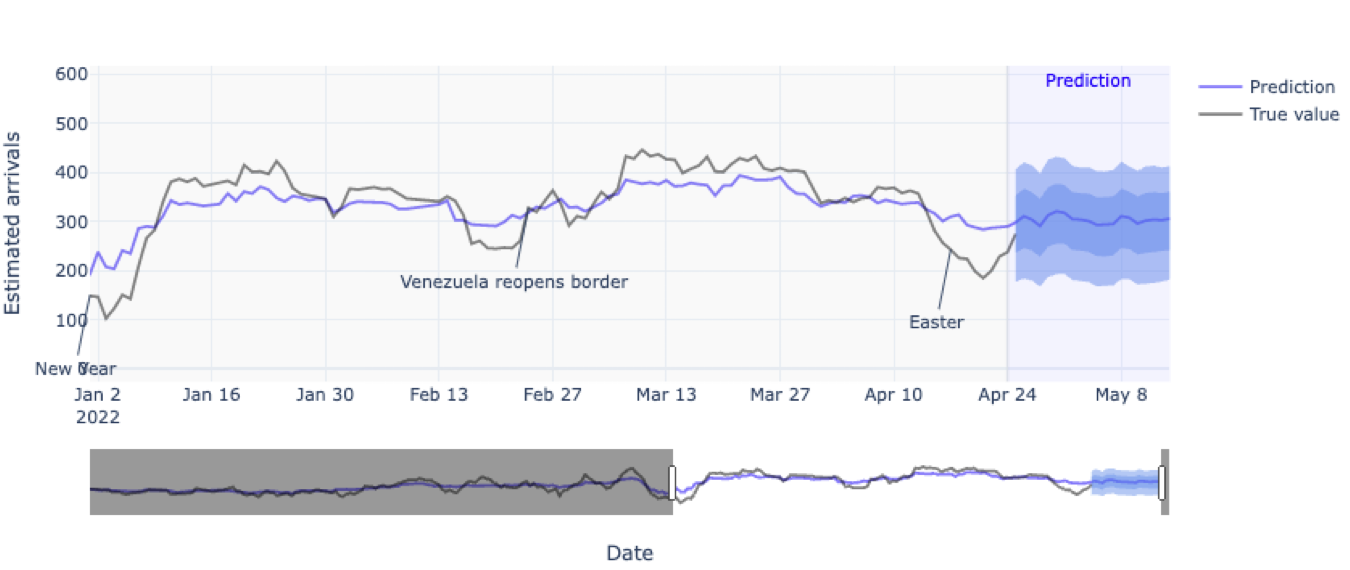
Humanitarian organisations often need to prepare for population movement with incomplete, delayed and sometimes contradictory information. A single forecast can conceal this uncertainty and create false confidence, particularly when policies, border rules and behaviour are changing rapidly. Indeed, the forecast is only one piece of the puzzle. By understanding the downstream uses of arrival forecasts, modelling approaches can better adapt to the core needs of humanitarian teams.
Research contribution
Work developed with UNHCR in Somalia and Brazil combined three linked capabilities: indicators of current conditions, predictive models for possible future arrivals, and a simulation of registration, shelter and relocation capacity. The emphasis was on presenting a range of plausible scenarios rather than treating one model output as the answer. The outputs of the statistical and machine-learning models fed into a differential-equation-based queue model, enabling the simulation of registration bottlenecks. By explicitly incorporating uncertainty quantification from the beginning, different scenarios could be assessed by likelihood and triggers for contingency plans could be developed.
Selected outputs