2020–present ·
Digital twins for public health
How can detailed population simulations support intervention planning while representing uncertainty and heterogeneous populations?
Agent-based and individual-based models of disease transmission spanning national policy planning in the UK and operational public-health interventions in refugee and internally displaced person settings.
The programme
JUNE is an open-source framework for simulating disease transmission through the interactions of individuals in a synthetic population. It represents households, schools, workplaces and other social settings using geographically and demographically detailed data.
The programme began with a national-scale model of England and was subsequently adapted to refugee and internally displaced person settlements, where population structures, available data and feasible interventions differ substantially.
Humanitarian application
In Cox’s Bazar, the model incorporated settlement geography, household structures, shared facilities and behavioural patterns. Scenario analysis examined isolation strategies, mask use and the reopening of learning centres. Related work developed lightweight approaches to estimating contact matrices and reconstructing population structures where conventional surveys are difficult to run by leveraging satellite image analysis.
Calibration, uncertainty and sensitivity
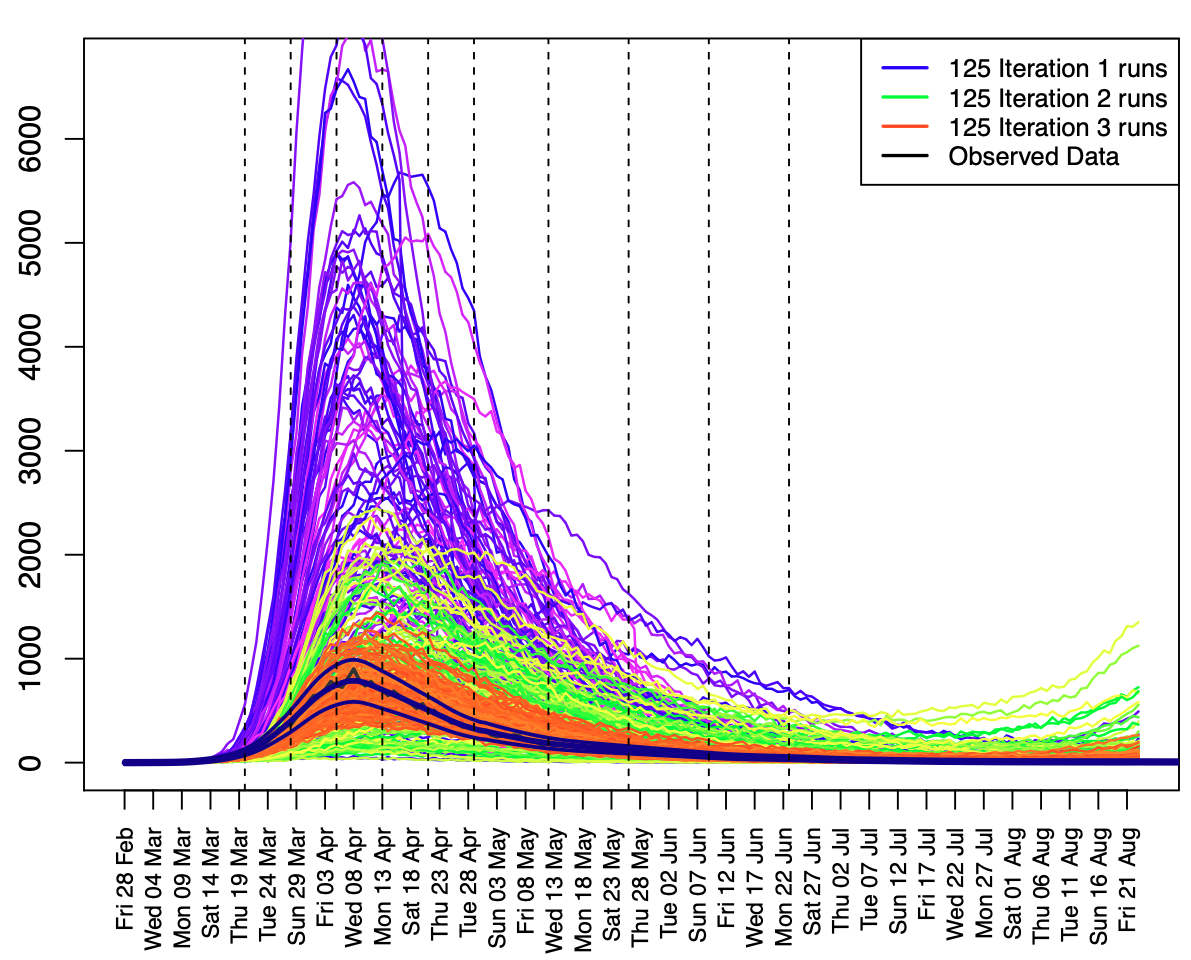
Detailed agent-based models are expensive to evaluate. This work therefore includes Bayesian emulation and history matching, as well as differentiable agent-based models that can accelerate calibration and provide gradient-based sensitivity analysis.
Selected outputs